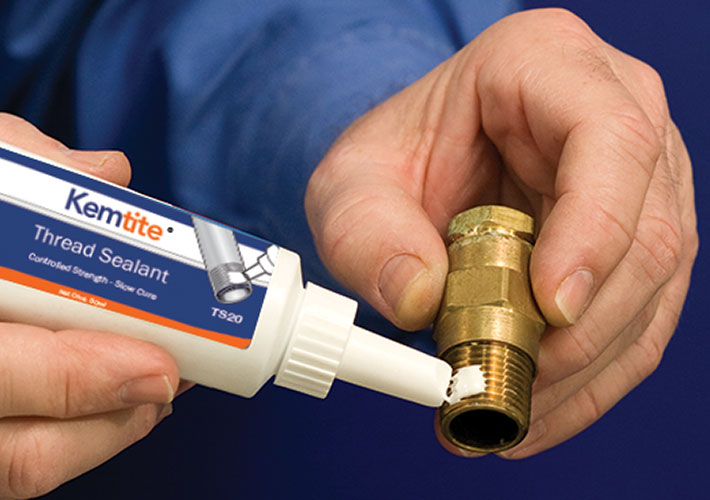
To apply thread sealant on a metal pipe or fitting, clean and dry the threads, apply a thin, even film of an anaerobic thread sealant to the male threads, assemble the joint without backing it off, and wait at least the fixture time given for that grade before you handle the assembly. Bring the system up to full working pressure only after the sealant has fully cured.
A leaking joint on a production line is often the result of the wrong grade, dirty threads, or a rushed cure. Chembond Material Technologies supplies Kem Vibra-TITE thread sealants through its partnership with ND Industries. This guide walks through how to choose a grade from that range, how to apply thread sealant correctly, and the checks that help the seal hold. If you want the basics first, start with what a thread sealant is and where thread sealants are most often used.
Choosing the Right Thread Sealant
Chembond’s Kem Vibra-TITE thread sealants are anaerobic products made to seal and secure metal pipes and fittings by filling the space between the threads. Used correctly, they help prevent leaks caused by tape shredding, vibration loosening, solvent evaporation, and damaged threads. They also have a lubricating effect, which makes assembly easier and helps prevent galling of the threads. The thread sealants range is designed for both low-pressure and high-pressure work, and for repairs the parts can be taken apart with basic hand tools where the grade allows it.
Differences between the Kem Vibra-TITE grades
Four grades are listed on the product pages. Use the published details below to match the joint, the metal, and the duty. Do not mix grades or assume one tube covers every job.
Kem Vibra-TITE 420 Controlled Strength Thread Sealant is an anaerobic thread sealing and thread locking compound with PTFE for pipe fittings. It is designed for sealing threaded fasteners that need to be taken apart with standard hand tools, and it has good temperature and solvent resistance. The key substrate is metal. Colour is white. Viscosity is 1,50,000 to 5,50,000 cP (paste). Maximum gap fill is 0.300. Sealing pressure is 70 MPa. Temperature range is -55 to 150°C. Fixture time is 60 minutes. Suggested primer is 611 or 612. It is supplied in 50 ml and 250 ml tubes (part nos. 42050 / 42025). See the controlled strength thread sealant page.
Kem Vibra-TITE 427 Medium Strength Stainless Steel Thread Sealant is an anaerobic thread sealant that is particularly suitable for stainless steel, and is designed to prevent leakage and vibration. Colour is yellow. Viscosity is 4,20,000 cP. Maximum gap fill is 0.300. Sealing pressure is 70 MPa. Temperature range is -55 to 150°C. Fixture time is 90 minutes. It is supplied in 50 ml and 250 ml tubes (part nos. 42750 / 42725). See the medium strength stainless steel thread sealant page.
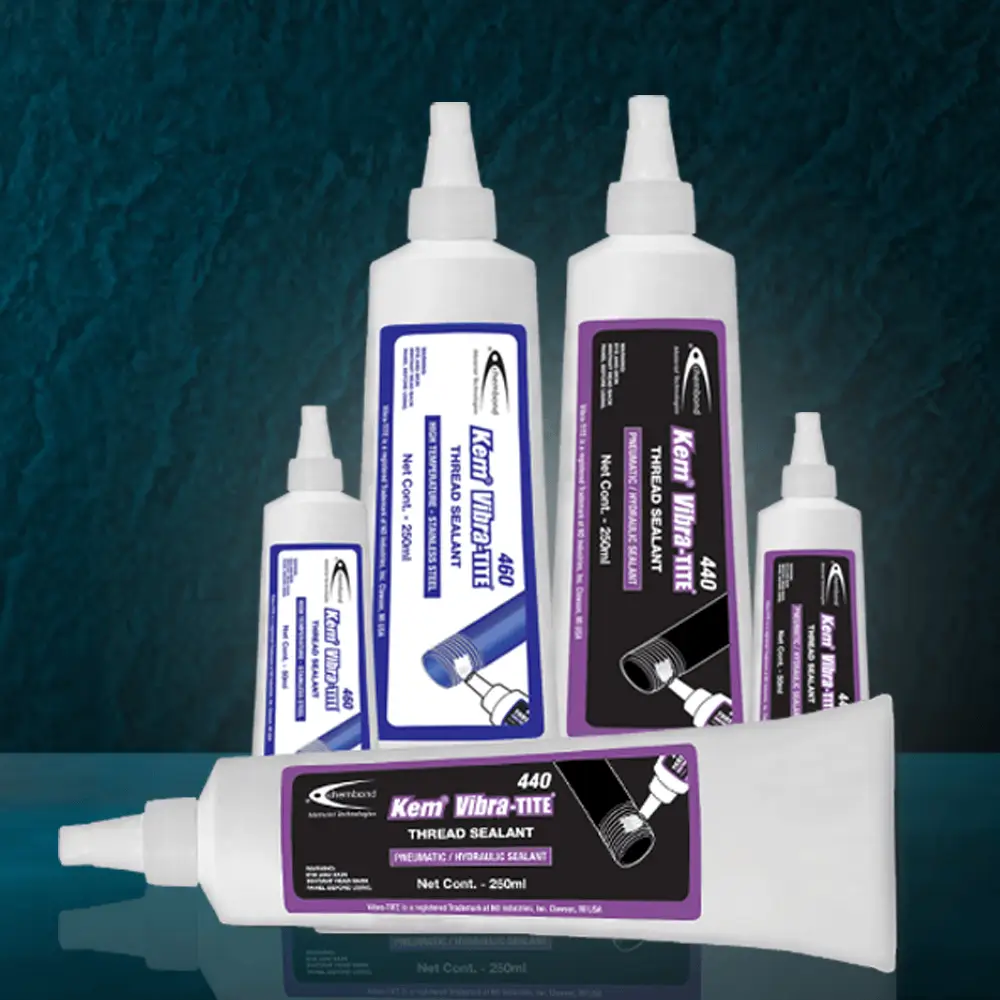
Kem Vibra-TITE 440 Medium Strength Stainless Steel Thread Sealant is listed for pneumatic and hydraulic work. The product page describes it as a fast-curing high strength anaerobic sealant that seals hydraulic and pneumatic fittings up to 2 inches in diameter, resisting high pressures and vibrational loosening. It is best suited for fluid, power and gas system connections. Colour is purple. Viscosity is 16,000 cP. Maximum gap fill is 0.175. Sealing pressure is 70 MPa. Temperature range is -55 to 150°C. Fixture time is 30 minutes. Suggested primer is 611 or 612. It is supplied in 50 ml and 250 ml tubes (part nos. 44050 / 44025). See the pneumatic / hydraulic thread sealant page.
Kem Vibra-TITE 460 High Temperature Stainless Steel Thread Sealant sets fast to give an instant low-pressure seal of 100 psi and a high-pressure seal when fully cured. This high strength product provides 100% sealing capability and does not shrink after curing, unlike more traditional solvent-based pipe dopes. It contains PTFE and is best suited for stainless steel and other inert metal threaded pipes and fittings. Colour is white. Viscosity is 3,56,000 cP. Maximum gap fill is 0.300. Sealing pressure is 70 MPa. Temperature range is -55 to 150°C. Fixture time is 60 minutes. Suggested primer is 611 or 612. It meets GM 1182607. It is supplied in 50 ml and 250 ml tubes (part nos. 46050 / 46025). See the high temperature stainless steel thread sealant page.
Kem Vibra-TITE thread sealant grades at a glance
| Product | Colour | Fixture time (min) | Viscosity (cP) | Max gap fill | Sealing pressure (MPa) | Temperature range (°C) | Pack size |
|---|---|---|---|---|---|---|---|
| 420 Controlled Strength | White | 60 | 1,50,000 to 5,50,000 (paste) | 0.300 | 70 | -55 to 150 | 50 ml, 250 ml |
| 427 Medium Strength Stainless Steel | Yellow | 90 | 4,20,000 | 0.300 | 70 | -55 to 150 | 50 ml, 250 ml |
| 440 Pneumatic / Hydraulic | Purple | 30 | 16,000 | 0.175 | 70 | -55 to 150 | 50 ml, 250 ml |
| 460 High Temperature Stainless Steel | White | 60 | 3,56,000 | 0.300 | 70 | -55 to 150 | 50 ml, 250 ml |
Figures in this table are taken from the Chembond product pages and have not been rounded or added to.
Application-specific sealant recommendations
- For hydraulic or pneumatic fittings, and for fluid, power or gas system connections up to 2 inches in diameter, use Kem Vibra-TITE 440.
- For stainless steel joints where you want a medium-strength seal that can be taken apart with standard hand tools, use Kem Vibra-TITE 427.
- For stainless steel or other inert metal pipes and fittings where you need a fast low-pressure seal and a high-strength, non-shrinking cure, use Kem Vibra-TITE 460.
- For metal pipe fittings that must come apart later with standard hand tools, and where a PTFE-filled controlled-strength grade is a good fit, use Kem Vibra-TITE 420.
Matching usage to product features
Look at more than the name on the tube. Viscosity and gap fill tell you how the product will sit on the thread: Kem Vibra-TITE 440 is much lower in viscosity (16,000 cP) with a 0.175 maximum gap fill, which suits tighter hydraulic and pneumatic threads, while 420, 427 and 460 are paste-like grades with a 0.300 maximum gap fill. Fixture times also differ, from 30 minutes for 440 to 90 minutes for 427. The 420, 440 and 460 pages suggest primer 611 or 612, which is worth planning for on inactive metal surfaces. 420 and 460 contain PTFE. 460 also meets GM 1182607 and is described as giving 100% sealing capability without shrinkage after curing.
If you are unsure which grade matches the metal, the pressure or the need to take the joint apart later, ask the Chembond Material Technologies team before you apply anything.
Preparation Before Application
A reliable seal starts before the tube is opened. Dirty, oily or wet threads are one of the most common reasons a joint weeps later.
Cleaning and drying threads
Remove loose debris with a wire brush or a lint-free cloth. Wipe the threads with a suitable solvent and allow them to dry completely. Oil, cutting fluid, moisture or dirt left on the metal can weaken the bond and shorten the life of the seal.
Safety measures and workspace preparation
Work in a ventilated area. Wear gloves and eye protection. Keep the tubes in a cool, shaded place, away from direct heat and freezing temperatures, so the product stays in a usable condition.
Organising tools and sealant for application
Set out the correct grade, the fittings, and any suggested primer before you start. Kem Vibra-TITE tubes have nozzles that help you control the flow. Open the tube when you are ready to apply, so you avoid waste and keep the work area tidy.
Step-by-Step Application Process
The steps below are the same in a workshop or on a production line. The grade you chose earlier does not change the sequence, but it does change how long you wait after assembly.
Thread engagement and sealant application
Apply only enough product to fill the threads, usually a thin bead along the male threads. Use the nozzle to spread an even film. Avoid a heavy coating. Surplus sealant can be squeezed into the system and affect flow.
Fitting assembly and alignment
Assemble the threads smoothly and tighten to the specified fit. Do not back the fitting off after tightening, as that can break the film. If the fitting needs to be aligned, make that adjustment during the first assembly. Once the joint is tight, leave it undisturbed while the sealant fixtures.
Curing and wait time guidelines
Use the fixture time published for the grade you have applied:
- Kem Vibra-TITE 440: 30 minutes
- Kem Vibra-TITE 420: 60 minutes
- Kem Vibra-TITE 460: 60 minutes
- Kem Vibra-TITE 427: 90 minutes
Kem Vibra-TITE 460 also gives an instant low-pressure seal of 100 psi, then a high-pressure seal when fully cured. Wait at least the fixture time before you handle the joint, and do not run the system at full working pressure until the product has fully cured. Always check the product page for your grade, the metal, and the conditions on the day. Cold parts, large gaps, or inactive surfaces such as stainless steel may need the suggested primer (611 or 612 on the 420, 440 and 460 pages).
Post-Application Care and Best Practices
The job is not finished when the fitting is tight. A short pause for curing, then a careful check, is what keeps the joint sound in service.
Allowing adequate curing time
Do not pressure-test at full load as soon as the joint is assembled. For Kem Vibra-TITE 460, the product page describes an instant low-pressure seal of 100 psi, with a high-pressure seal when fully cured. For every grade, respect the fixture time and wait for a full cure before the system runs at working pressure.
Inspecting sealed joints for leaks
After the fixture time, carry out a careful pressure check at a safe test pressure. If you find seepage, take the joint apart, clean the threads thoroughly, and apply a fresh film. Adding more sealant over a weeping joint is not a reliable repair.
Mistakes to avoid for long-term results
- Skipping the clean-and-dry step, so oil or dirt sits under the film.
- Using the wrong grade for the metal, the thread, or the duty. A paste grade is a poor match for a tight hydraulic thread that needs the lower viscosity and smaller gap fill of Kem Vibra-TITE 440.
- Applying too much product, which can squeeze into the line and contaminate the system.
Maintenance and Removal
These sealants are made to last in service, and the right grades are also made so you can service the joint later.
Removal of thread sealant
Kem Vibra-TITE 420 and 427 are designed for disassembly with standard hand tools. For high-strength grades such as 440 and 460, use suitable tools and follow the guidance on the product page. Once the fitting is apart, remove the old residue with a brush that will not damage the threads.
Reapplying thread sealant after disassembly
Do not reuse old sealant. Clean the threads again, remove any hardened paste and oil, apply a fresh film, reassemble, and allow the published fixture time once more, just as you would on a new joint.
Routine checks for maintenance
During planned servicing, inspect older joints. If a fitting feels loose or residue has built up, clean the threads and apply a fresh film before the joint goes back into service.
Benefits of a Correctly Applied Thread Sealant
A well-chosen, well-applied thread sealant does more than stop a drip. It helps protect the joint from leaks under pressure, resists loosening from vibration, and, because of its lubricating properties, makes assembly easier and helps prevent galling. The range also offers corrosion protection on threaded connections. Kem Vibra-TITE 460 does not shrink after curing, unlike traditional solvent-based pipe dopes. When joints are sealed correctly the first time, unplanned stops for rework are less likely. For typical industrial uses, see where thread sealants are most often used.
Common Mistakes and How to Avoid Them
Most leaks after assembly come from a small number of avoidable errors.
Misidentifying the thread or the metal
Straight and tapered threads, and active versus inactive metals, do not always behave the same way. Stainless steel and other inert or passive metals are a natural fit for 427 and 460, and they may need primer 611 or 612 with 420, 440 or 460 so the anaerobic cure can proceed as intended.
Ignoring fixture and cure conditions
A cold workshop, an oily thread, or a joint that is moved after it has started to fixture can all spoil the seal. Do not re-tighten a joint once the sealant has set.
Substituting tape or an unmatched sealant
PTFE tape is quick to apply, but it can shred or tear during tightening and may not hold as reliably where vibration or pressure is high. A liquid anaerobic thread sealant fills the space between the metal threads and is the better match for many industrial pipe and fitting joints.
Frequently Asked Questions
How long does thread sealant take to dry?
Fixture times on the Kem Vibra-TITE product pages are 30 minutes for 440, 60 minutes for 420 and 460, and 90 minutes for 427. Kem Vibra-TITE 460 also gives an instant low-pressure seal of 100 psi, then a high-pressure seal when fully cured. Check the product page for your grade before you pressurise the system.
Can I use thread sealant on plastic threads?
The Kem Vibra-TITE thread sealants in this range are described for metal substrates, including stainless steel and other inert or passive metals. If your joint includes plastic, speak to the Chembond Material Technologies team before you choose a grade.
How does thread sealant compare with PTFE tape?
Liquid anaerobic thread sealants fill the space between threaded metal parts and help prevent leaks caused by tape shredding, vibration loosening, solvent evaporation and damaged threads. PTFE tape can tear or shred during tightening and may be less reliable where vibration or pressure is high.
What is the difference between thread sealant and threadlocker?
Thread sealant fills gaps to stop fluid or gas leaks on threaded pipes and fittings. A threadlocker is used to lock fasteners in place and help prevent loosening. Choose the product that matches the job. If you need a threadlocker, see the threadlockers range.
Talk to Chembond Material Technologies about thread sealants
If you need help matching a Kem Vibra-TITE grade to your pipework or fittings, call +91 22 6264 3000, email info@chembond.in, or use the contact page.